Blackjack Strategy Guide
If you have played blackjack, you know the game isn't tough to learn. But did you know different strategies yield different results? Read more here.

On this page — 17 sections
- Best Online Gambling Sites 2026
- A Little Blackjack History
- Beat the Dealer
- Blackjack Basic Strategy
- Your First Time Playing Live Blackjack
- Surrender
- Choosing the Right Blackjack Dealer
- Choosing the Right Table Limit
- Bankroll Requirements
- Getting Comped for your Play
- Blackjack Card Counting Systems
- The Making Money Part
- Single-Deck Blackjack Games
- Taking Insurance
- Counting Aces
- Multiple-Deck Blackjack Play
- Bet Size and Bankroll Size
Updated:
It seems like there are blackjack games everywhere these days. In bars, dorm rooms and online. Or you can go to a casino and play. Maybe it is because the game is easy to learn and fun to play. You don't have to be a genius; you just have to have a plan. The backstory to the fun part is that some players have perfected a way of playing called basic strategy that reduces the house edge to about half a percent. This is tiny compared to slot machines that have a 10% house edge.
And if you have ever heard that playing blackjack as an expert is against the law or dangerous, it is not. Casinos may not like it, but the worst they can do is ask you to stop playing, and that is unlikely to ever happen unless you are counting cards and winning thousands. By then, you will understand the importance of playing under the table and staying under the radar.
Some of the information here will cover etiquette for playing blackjack in land-based casinos, but the gameplay itself is the same whether you choose to play in a land-based casino or in an online casino like one of the ones we recommend. Either way, I will make sure you know everything you need to know in order to be successful at the game.
Also know that learning does not happen all at once. You can read a few pages and come back anytime for more information. It is all here, and it is all free, so get started.
Best Online Gambling Sites 2026
10 sites · checked


Order is set by our published method — payout record, licence, banking and complaint history. Links marked «Visit site» are commercial. How we rank
A Little Blackjack History
At first glance, Blackjack is a simple game. You try to beat the dealer's hand by drawing cards until you get close to 21. If you go over 21, you lose. If the dealer goes over 21 and you do not, you win. The only challenge is knowing how to play your cards without failing. Learn the game today! So, read and rule!
Double downs, splits and 3 for 2 in blackjack came later, just before legalized gambling in Nevada in 1931. At that time, gamblers preferred poker and roulette. Although casinos had blackjack on one or two tables, it was not a trendy game. That changed in the 1950s, when a few savvy gamblers began to take advantage of the game and its flexible betting rules.
What some players discovered was that they could game the system a little bit by watching how many aces were dealt and increasing their bets when the aces were still in the deck. At the time, tables in Reno and Lake Tahoe relied on single decks. Most games in certain Las Vegas venues did as well. Those days were unforgettable.
With players getting 3 for 2 on Blackjack, they were doing well, but not always well enough to beat the casino's odds and consistently win the game. What they really needed was a strategy for each hand. Enter the wise doctor Edward Thorp and the age of computers.
Beat the Dealer
Although Thorp was not the first person to see the need for an optimized blackjack strategy, he was the first to use a computer to simulate the game and create an overall system to improve a player's odds at the table. After more than a year of programming and simulations, Thorp perfected what he called Basic Strategy (more on that soon), similar to what mathematician Roger Baldwin had developed in 1956.
A month later, Thorp convinced professional gambler Manny Kimmel to front him $10,000 and double the money in a single weekend. The bosses were skeptical and upset, so Thorp decided to go to Las Vegas, where there were more casinos. Although he did not repeat his success in Reno on his first trip, he found a groove and had good results on weekend forays for the next few months. He kept his side job teaching college math. His success convinced him that there might be a good book in his story.
That book, Beat the Dealer, introduced readers to Dr. Thorp and his Ten Count, which was used to keep track of the makeup of the deck and the players' changing odds of winning. The book was reviewed in Time magazine, it hit the New York Times bestseller list, and suddenly Las Vegas did not have enough blackjack tables to keep the throngs of players flocking to Las Vegas happy.
Unlike players in the 1960s who had a hard time finding legal casinos, there are now clubs all over the world where you can play blackjack. Not every location has the generous rules that Atlantic City and Las Vegas offer, but with practice, you can play almost on par with the casino by following basic strategy.
Blackjack Basic Strategy
If you already know how to play Blackjack, great. You know when to hit and stand, how to double down, and which pairs to split. What basic strategy does is take you further with specific moves against every up card the dealer shows. And by learning this strategy, you can reduce the house edge to as little as 0.5%.
You should also be aware that some clubs have instituted 6-to-5 payouts for blackjacks instead of the standard 3-to-2 (which is 7.5-to-5). This change is terrible for the player. If you have no choice, then play the 6-5 game if you want, but it is not a good game. You will play your hands much the same as outlined in our Beginner's Blackjack Guide. You will always hit, split or double down until you have at least a hard 12.
Hard Hands
You'll still have plenty of options once you reach hard 12, so follow these rules for each hand.
- Hard 12: Stand if the dealer's up card is 4, 5, or 6. Otherwise, take a hit
- Hard 13: Stand if the dealer's up card is 2, 3, 4, 5, or 6. Otherwise, take a hit.
- Hard 14: Stand if the dealer's up card is 2, 3, 4, 5, or 6. Otherwise, take a hit.
- Hard 15: Stand if the dealer's up card is 2, 3, 4, 5, or 6. Otherwise, take a hit
- Hard 16: Stand if the dealer's up card is 2, 3, 4, 5, or 6. Otherwise, take a hit. An exception can be made to hit your hard 16 against a dealer's 10 or ace if you see many small cards and few tens on the board.
- Hard 17 or higher: Stand unless you have a split or soft hand;
Hard Double-Down Hands
You'll only want to double down on 9, 10, and 11 according to the rules below.
- Hard 9: Double against a dealer up card of 3, 4, 5, or 6. Otherwise take a hit
- Hard 10: Double against a dealer's up card of 2 through 9. Hit a 10 or ace
- Hard 11: Double against a dealer's up card of 2 through 10. Hit against an ace;
Soft Double-Down Hands
If you can double down on soft hands, follow the rules below. You will always stand on soft 19 and 20.
- A-2 and A-3: Double against a dealer's up card of 5 or 6. Otherwise, take a hit.
- A-4 and A-5: Double against a dealer's up card of 4, 5 or 6. Otherwise, take a hit.
- A-6: Double against a dealer up card of 3, 4, 5 or 6. Otherwise, take a hit
- A-7: Double against a dealer's up card of 3, 4, 5, or 6. Stand against a 2, 7, or 8. Beats a 9, 10, or ace;
Pair Splits
Splitting pairs is an art in itself. If you can memorize these splits, you will do much better at blackjack. The easiest thing to remember is to always split Aces and Eights. The aces make sense because you have a huge advantage when you start a new hand with an ace. However, splitting a pair of 8s against a dealer's up card of 9, 10, or an ace may seem crazy.
It is still the best, because if you miss, you are stuck with a 16, which is worse. The following splits are the right move, honestly. All proven by millions of computer simulations.
- Holding 2-2, you should split against a dealer 2 through 7 and hit against an 8 through an ace
- holding 3-3, you should split against a dealer 2 through 7 and hit against an 8 through an ace
- holding 4-4, you should hit
- holding 5-5, you should play your hand as a 10 and then hit or stand according to the double-down rules
- holding 6-6, you should split against a dealer 2 through 6. Otherwise, play as a 12
- holding 7-7, you should split against a dealer's up card of 2 through 7. Otherwise, play as a 14.
- Holding 8-8, you should always split.
- Holding 9-9, you should always split except against a dealer card of 7, 10 and ace.
- Holding 10-10, you should be happy and tuck your cards under your money
- you have 20.
That-s it for splits. And so much for basic strategy. After memorizing the rules, you can play comfortably in any casino knowing that the house edge is as low as it will go until you try a card counting system. Still, there are some general rules you will want to learn that follow.
Your First Time Playing Live Blackjack
Now you can move forward with some practice sessions. I know you think you have it and are ready to play for money, but you should still take some time to practice. Listen, Steph Curry practices his jump shot every day and he has been playing basketball for 25 years. Does Tiger Woods still practice his chip shot and drives before a tournament? Of course he does, and those guys get paid a lot of money. Shouldn't you practice before you risk your money?
In the US, the best odds are found in Atlantic City and on the Las Vegas Strip. You can find single deck games on the Strip, but most properties offer six deck shoes. In Arizona, you get the same games, plus you can re-split Aces. A single-deck game is usually best, unless they try to sneak you the dreaded 6-5 blackjack payoffs. Then forget it. Otherwise, a single-deck game is 0.48% better than an 8-deck shoe. There is a big difference.
Great rules for the player include the standard dealer hit on a soft 17, double on any two cards, and split any pair to make up to four hands (aces may or may not be re-split). Some other options that help include
- Early surrender + .24%
- Double down on any number of cards + .23%
- Redraw to split Aces + .19%
- Re-split Aces + .08
- Late surrender + .8%;
The number of decks is important. Compared to an eight-deck shoe, your odds improve with these numbers:
- Six decks + .02%
- Five decks + .03%
- Four decks + .06%
- Two decks + .19%;
Rules that increase the house edge and work against the player should be avoided whenever possible. An example of this is the even money payout on blackjack found on older video games (-2.27%). Some other rules include
- Split pairs to only three hands -.01%
- Double down on 9, 10 and 11 only -.09%
- Split to only two hands -.1%
- European no hole card -.11%
- No double down on split pairs -.14%
- Double down on 10 or 11 only - .18%
- Dealer hits soft 17 -.22%
- Blackjack pays 7 to 5 -.45%
- Blackjack pays 6 to 5 -1.4%;
Are these rule changes hurting you? Well, the change to 6-5 Blackjack payouts alone will cost you 1.4% of your average bet per hour. If you bet $10 per hand and play 60 hands, that is 14 cents times 60, or a total of $8.40 per hour. Ouch!
Surrender
One of the options you may or may not be offered is to surrender half of your bet after seeing your first two cards. This may seem like a terrible thing to do - giving up half your money before even trying to improve your hand - but hear me out. You only want to do this if you are holding a hard 15 and the dealer shows a ten, or if you are holding a hard 16 and the dealer shows either a 9, 10, or an ace. And you will never do it with a soft hand.
That 23 times gives you 46 units. For every 100 hands, 54 units. That is pretty bad. When you use the surrender option at a land-based casino, you run your finger horizontally across the layout in front of your bet, and the dealer takes half of your bet. In this case, after 100 surrenders, you will have 50 units left. This is still terrible, but it is the lesser of two evils. And you save four units, which makes the play correct.
This does not apply to a 16, which is a pair of 8s. You would still split the 8s because you would only lose with them 47% of the time, and that is better than taking the 50% surrender return! So if you have the option to surrender, do so only with no pair and hard hands, 15 against a 10, and 16 against a 9, 10, or Ace. You may only get this opportunity three or four times an hour, but if you bet $10 per hand, you will still save a few dollars.
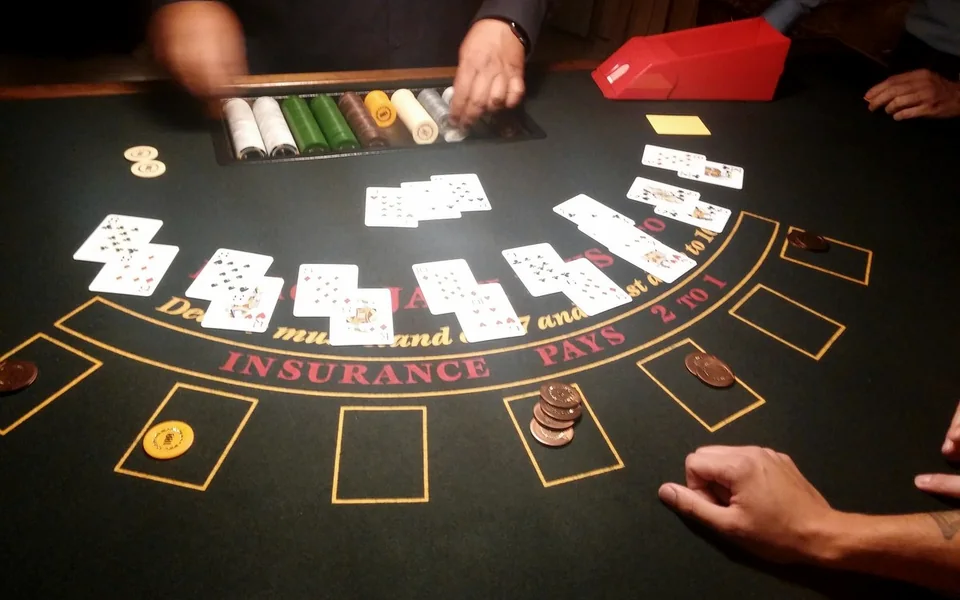
Choosing the Right Blackjack Dealer
No one likes a grumpy dealer. You might as well pick someone who at least smiles, right? A happy, experienced dealer is usually your best bet. They will deal a good number of hands per hour and will not rush you. The more relaxed you are, the better you will play. This is important. You want to have time to make the right decision on each hand. Do not let the dealer or other players rush you. If you are confused about something, ask. That is what the dealer is there for - to help you.
In most cases, the dealers will do their best and talk to the players when possible. You get what you give. And giving the dealer an occasional tip will go a long way in keeping their spirits up. They work for minimum wage and need tips just like waitresses. How much should you tip? The nicer they are, the more I tip. Win or lose. I always tip more when I win. The actual amount is up to you, but an average tip is not a bad idea.
Choosing the Right Table Limit
Remember to check the table limits before you sit down. Higher-limit tables may have players who get annoyed no matter how fast or slow, good or bad, you play.
Low-limit games are likely to be more fun with less pressure. This is usually better for beginners, and until you are a pro at basic strategy, you are a beginner. That is okay; take your time and make the right plays. Once you feel comfortable, you can move up to higher minimum limit tables, but there is no rush. The same goes for online live dealer games. You have plenty of time to act, and there is no pressure when you play at the minimum limit tables.
If you feel comfortable with a higher limit, feel free to try it, but we may want to discuss your bankroll first.
Bankroll Requirements
It does not matter how well you play if you have no money. Since playing Blackjack is gambling, you cannot reasonably expect to win at any given time. All you can do is set aside some money for entertainment and give it a try.
Personally, I have always been a stickler for a strict bankroll. But not just your total bankroll, but your table stakes. I think in units, not dollars. Chip stacks rise and fall like waves on the ocean, so I like to have at least 20 units to work with at every table. If the table minimum is $10, I like to have at least $200 to start with.
You can avoid these problems by taking your time, having a reasonable bankroll, and not drinking too much. And you can help yourself by choosing a table minimum that fits your wallet. Sure, it is fun to sit at the $25 table, but if you only have $200, that is eight units. You can burn through that in two or three hands if you get a couple of double-downs that go bad.
Ideally, what you bring to the table is only a portion of your bankroll. I like to have only 5% of my cash on the table at any given time. So, with a $4,000 bankroll, I will bring $200 and probably play at a $10 table. How much can I bet per hand? As a beginner, I think you should stick with a bet like $10 and only raise if you are winning. Streaks do happen, and it helps to increase your bets slightly as you win more hands. When bad streaks happen, you want to get down to the limit and ride it out.
Â
Getting Comped for your Play
One of the great things about playing online and live blackjack is that you can join the casino's player club and earn free bonuses. Comps in live casinos are for food and beverage and hotel rooms. You can also usually use your Players Club card to make purchases in the gift shop. You may not earn as much on an average $10 bet (about a dollar an hour), but it adds up.
When you sign up for a card for the first time, you also get a bonus - maybe a T-shirt, maybe $20, but anything is good. If you join an online site, you get a match bonus, which gives you more to play with. However, you should be aware of the rules and regulations. Usually, your blackjack play does not count toward clearing your bonus (so you can withdraw your money).
As for online comps, they come in the form of free money to use in the slots and at the tables. They also have to be cleared, so again, grab your reading glasses and check the rules. Once you have practiced and understood most of the basics presented here, you may want to go ahead and read about card counting. You need to be strong in basic strategy to move on, but you can learn about it first. And I will tell you about single-deck rules and multi-deck stuff, too.
Blackjack Card Counting Systems
Card counting is a system that allows the player to know when he has a small advantage over the house. This allows the player to bet more money at the right time and change his game slightly. If the count is negative, the player gets his base bet as low as possible. Otherwise, the counter plays basic strategy and tries to look as inconspicuous as possible.
It is much easier to learn to count and play in your spare time for entertainment. If you do that, you will probably find that you can win some money and get some free rooms and food. That is a good goal to have. Card counting works because the casino's advantage in Blackjack changes as cards are removed from the deck during play. The player acts first and risks a bust, but the player does not have to hit while the dealer does. When many small cards are removed from the deck, the dealer is more likely to draw a big cad and bust.
Tens and Aces also help the player make Blackjack and get paid 3 to 2, while the dealer can only beat you for even money with Blackjack. All those extra tens in the deck also help you make a big hand when you double down, so this is a good time to raise your bet. We like all those tens in the deck, so when the small cards come out, we count positive numbers. When the tens come up, we count in the negative. If the count is positive, the player has the advantage and we bet more. If the deck is negative, we bet as little as possible.
A simple Hi-Lo count works like this: cards 2, 3, 4, 5, and 6 are plus one (+1); cards 7, 8, and 9 are zero (0); and all tens, face cards, and aces are minus one (-1). Take a regular deck of cards and count through them, adding and subtracting one for each card, skipping over 7, 8, and 9. You may find that there are 20 cards (2, 3, 4, 5, 6) that are plus one and 20 cards (tens and aces) that are minus one.
If you only took a few tens out of the deck, your count would be minus two, and the house would have the edge (even at zero). Counting and knowing when you have the edge is that simple! There are more advanced counts, but it is best to start with something reasonable. Master this count before moving on.
If you try this on a single deck game, keeping track of the count is pretty easy. The more you practice, the better you will get. Just keep going through your deck, one card at a time, saying -one,- -plus one,- -plus two,- -plus one- as you go. You will want to keep practicing until you can go through a deck perfectly in about 30 seconds.
The Making Money Part
You can really make some money counting cards if you play perfect basic strategy and learn a counting system. To do this, start with a single deck game, the first hand after the shuffle, and bet the table minimum. If the count stays at zero or is negative after the first hand, keep your bet small.
Keep in mind that while you may be new to the game, the pit bosses are not. They are trained to notice players who vary their bets at opportune times. Fortunately, most players vary their bets at all sorts of contradictory times. This means that they will not see you as a threat unless you do things like bet 1 unit until you have a big lead and then throw down a 10 unit bet. That will get noticed.
You may want to start small and work your way up during positive decks. Say you find a $5 game and you are given some $5 chips and some $1 chips. Each time you win, add $1 to your bet. If the count is positive, add two or three, but no more than $5. If you lose a bet, drop back down to $5. It's not a perfect system, but start by walking. You can run later.
Single-Deck Blackjack Games
I prefer to play single deck games because I can count cards easily. I do not have to wait so long for good shoes to turn profitable, and if I make a mistake and lose count, it is only two minutes before the deck is shuffled again.
It is important that you play cat and mouse with the pit bosses when you play a single deck game. They may be waiting for a new deck and counting you down to see if you change your bets with the count. Be careful. When you play alone, you can be dealt a lot of hands in an hour. While this simple Hi/Lo count may only be worth a tiny percentage in your favor, you will win a lot more getting 200 hands per hour than the 60 you might get at a crowded table. So choose your tables wisely.
Taking Insurance
Insurance is usually a bad bet because the odds of winning are 16 out of 51, or 16-35, which is less than 50%, and that is what the bet pays. On the other hand, if you are playing a single deck and it is the first hand with three players on the table, and the six cards you can see are all small cards, the count is positive, and now the odds are in your favor. You would win 16 times and lose only 29 times, a positive edge (you win 55% of the time).
Counting Aces
Getting a Blackjack payout is always great, and if there are a lot of Aces in the deck, you will get more Blackjacks. Suppose you saw ten cards after the first round of betting, and none of them were aces. That is good. Now suppose the count is positive. Instead of just increasing your bet a little, you can safely add an extra unit to your bet. If, on the other hand, two aces were dealt, you might keep your bet at a single unit, even if the count is positive. The truth is that you do not have much of an advantage now.
Overall, you will win about 43% of the hands you play, fold almost 9%, and lose 48%. You make up for the extra losses by doubling down, splitting pairs, folding, and maybe even hitting a few blackjacks. By counting and increasing your bets when you have the advantage, you will earn more with each win.
Multiple-Deck Blackjack Play
The Hi-Lo (or Plus Minus) count was designed for single deck play. As casino managers saw more counters, they began adding decks to the tables. Today, six- and eight-deck games dominate the casino industry. Bummer! But that does not mean you cannot win; you just have to work harder. As a beginner with a Hi-Lo count, all you have to do is keep track of the count and raise or lower your bets. With multiple decks, you need to keep a current or running count and divide the remaining decks by that number to get a true count.
Don't worry, the math is always pretty simple, and you don't have to do it if the count is negative, right? Just stay with the single unit bet. So, what is your edge with this simple count? With favorable rules and perfect basic strategy, you can have an edge over the house of as much as 0.60%. You may not get rich, but you can win! But there is one more thing you need to know.
You need to have good variance in your bets to win in any counting system. If you go slow and vary your bets from $5 to $20, you will have a slight edge. If you get more confident and vary your bets from $5 to $40, you will get about a .40% edge. You cannot hit that .60% edge until you are enjoying a 1 to 10 spread ($5 to $50).
If you are wondering about taking insurance, it is the same with a single deck as it is with multiple decks. On a single deck, you should take insurance (when the dealer shows an ace) any time the count is higher than +3. With multiple decks, you have to do the math again and turn your running count into a true count. If the true count is greater than +3, insurance is a good bet.
There, you hope to turn things around and get a 0.60% edge for your play. If you play well enough and get 60 hands per hour with an average bet of $25 (average, not your base bet or your highest bet), you are putting $1500 into play. That earns you about $9. If the dealer is fast and you get 100 hands an hour, you could earn $15 an hour, plus your comps. Pretty sweet.
Bet Size and Bankroll Size
Whether you are learning to play Blackjack for the first time or learning to count Hi-Lo, chances are you will lose money the first few times you play. This is not a bad thing; it is a learning curve. You have to get the basics down first. Then you can start winning.
When you are short of money, you are more likely to make mistakes and pass up good opportunities. Do not say things like "Oh, I am not going to double down because I do not have the money" and expect to win. Those double downs and split hands are usually the difference between winning and losing each night.
Why? Because you win these bets more often than you lose them, and that makes all the difference. Don-t guess or -go with your feelings- instead of following basic strategy. This is a recipe for disaster.
Gambling has an emotional content that can hit you like a truck. Gamble with money you can afford to spend on entertainment, not your rent money. Carrying that baggage is crippling. Gambling is not a sure thing, but playing blackjack with basic strategy is a good start.
Checked by the USOnlineCasinos deskLedger entry updated . We re-open every page when a licence, a payout rule or a banking limit changes — the date above is the last time this one was verified against the operator. Our method · Report an error